Event 1
梅丽莎·沃尔什遭绑架

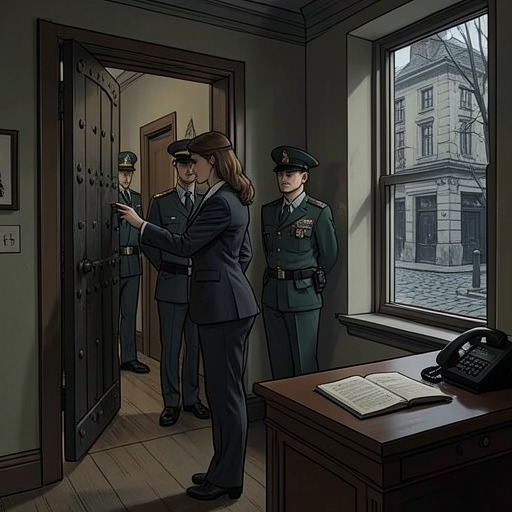
The kidnapping of [Melissa Walsh](entity:character-recall-character-melissa-walsh-4644f6d97afa) is established through a trail of disturbing clues: she has gone missing, her phone’s tracker places her travelling away from school, and her backpack—with her exercise books and [Ventolin inhaler](entity:object-recall-object-ventolin-e5ce8dee68dc) inside—has been found discarded. The discovery transforms a father’s fear into a police inquiry and gives the detectives concrete grounds to investigate [Ryan Walsh](entity:character-recall-character-ryan-walsh-b87d5a821abe)’s suspicion that the O’Neills have taken his twelve-year-old daughter.
## Causes and First Signs
The immediate alarm is raised when police learn that the missing girl is the twelve-year-old daughter of one of their suspects. Ryan Walsh believes she has been kidnapped. The revelation catches Jo by surprise, but she recognizes the father’s name; Gordon’s account makes the disappearance part of the detectives’ existing investigation rather than an isolated missing-person report.
Walsh has already tried to establish what happened without telling his daughter. He says he secretly installed a tracker on [Melissa](entity:character-recall-character-melissa-64b753949b14)’s handset. After Morris told him she had not turned up, Walsh checked its location: the phone showed her travelling south on Palatine Road, shortly before the road reaches the motorway. Jo estimates that point is about three miles from the school, too far for Melissa to have covered on foot in the time available. The tracker therefore offers an early indication that she may have been taken by vehicle, although the excerpt does not establish who was driving or where Melissa herself was.
## The Abandoned Backpack
A call from Melissa’s school supplies a second, physical clue. Mrs Harrison, the bursar, tells Ryan Walsh that a member of the public found a backpack on the pavement outside her front door. It contained Melissa’s exercise books and her Ventolin inhaler. The bag’s contents connect the object directly to the missing schoolgirl, while the presence of the inhaler makes the discovery especially alarming in light of [Melissa’s asthma](entity:state-recall-state-melissa-1e8802506e9d).
The address gives the detectives a route to consider. Carter identifies Mabfield Road as lying on the far side of [Platt Fields Park](entity:location-recall-location-platt-fields-park-e4a627e58176) and leading onto Wilmslow Road. Mrs Harrison says that girls who live nearby sometimes walk home through the park, and suggests Melissa may have taken that route. Her possibility sits uneasily beside Walsh’s tracker information: the phone had appeared to travel south on Palatine Road, while the backpack was found near a route associated with the park. The evidence points to a trail, but does not yet explain how the bag came to be discarded or what happened to Melissa after it was separated from her belongings.
## Police Inquiry and Family Stakes
The school call is heard on speakerphone at Fox’s insistence. When Mrs Harrison asks whether the school can help, Walsh curtly ends the call and turns back to the detectives. He insists that Melissa could not have abandoned the backpack herself and accuses the O’Neills of having her. His threat to retaliate if they harm her is left unfinished when Fox tells him it is better not to say more.
Fox then asks Walsh to hand over his phone, presenting cooperation as being in his daughter’s interest. Walsh hesitates. Jo reads his pause as a calculation between the danger to Melissa if he withholds the device and the danger to himself if the police trace it back through his questionable contacts. His reluctance places the investigation inside a larger conflict: the father’s urgent need to find his daughter is entangled with the possibility that police scrutiny could expose his own dealings.
## Significance of the Clues
The kidnapping is not shown directly in these scenes; it is reconstructed through what is missing and what has been left behind. A concealed phone tracker, an implausibly distant location, and a schoolbag emptied of its ordinary function turn routine objects into evidence of a disappearance. The backpack’s contents mark Melissa’s absent presence, while the tracker opens a path beyond the school and into the detectives’ search.
The sequence also keeps suspicion distinct from proof. Walsh names the O’Neills as responsible, but the evidence presented here confirms neither their involvement nor Melissa’s whereabouts. What it does establish is the urgency of the case and the competing pressures on those trying to respond: the police need Walsh’s phone and information, while Walsh fears the consequences of surrendering them even as his daughter remains missing.
Event 2
Ronnie O’Neill’s assault on Benjamin Stanley
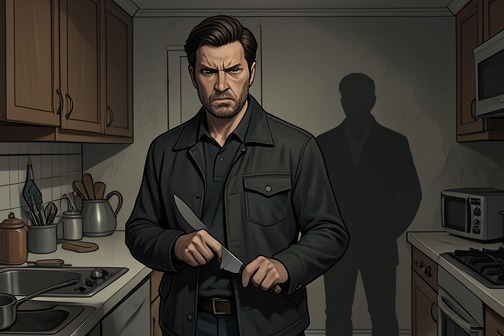
[Ronnie O’Neill’s assault on Benjamin Stanley](entity:event-recall-event-7f7464323951) was the offence behind O’Neill’s sole conviction and imprisonment, and a disputed act of violence rooted in a struggle over criminal territory. The book revisits it as police assess the implications of O’Neill’s recent parole: what happened in Stanley’s kitchen is not presented as a settled account, and the uncertainty sharpens concern about whether old hostility might become new retaliation.
## Background and Criminal Context
O’Neill was described as the long-standing boss of a South [Manchester](entity:location-recall-location-manchester-4236006a4a66) crime syndicate, suspected of involvement in drugs, extortion, armed robbery, kidnapping, and grievous bodily harm. Despite that wider suspected activity, the assault on Stanley was the only offence for which he had been convicted. The police discussion identified the conviction as the reason he had been imprisoned, giving the assault particular significance in an account of a man whose alleged criminal reach far exceeded what had been proved in court.
The assault followed a challenge to O’Neill’s territory. Stanley was attempting to establish himself in that territory with drugs allegedly obtained from a criminal group in Newcastle. O’Neill and his associate [Steven Yates](entity:character-recall-character-steven-yates-ea985a462ced) went to Stanley’s home, turning a dispute over competing criminal interests into a direct confrontation. The account does not establish that the drugs’ alleged source or Stanley’s wider activity was proven; it presents them as part of the reported background to the visit.
## The Disputed Assault
The remembered account centres on a meat cleaver in Stanley’s kitchen. O’Neill and Yates said Stanley picked it up from the central island and threatened them. [Jo Stuart](entity:character-recall-character-jo-stuart-5a4f22fe2dbd) regarded that version with suspicion, suggesting that Stanley was more likely defending himself. The sequence is therefore recounted through opposing interpretations rather than as an uncontested reconstruction of who initiated the danger.
What was not disputed was that O’Neill wrestled the cleaver away from Stanley and that Stanley lost part of an ear in the encounter. O’Neill maintained that the injury happened accidentally during the struggle. Stanley said O’Neill deliberately swung the cleaver after taking it from him, and Stanley’s wife corroborated his account. Yates, by contrast, supported O’Neill’s version. The conflicting testimony leaves the decisive question of intent unresolved in the later retelling.
## Conviction and Later Significance
The prosecution resulted in a conviction for grievous bodily harm. In the police conversation, Jo considered that charge understandable given the competing accounts, while noting that both men might have reason to seek revenge. The assault thus functions not only as the explanation for O’Neill’s imprisonment but also as a continuing source of risk: the participants’ versions differ, and neither the underlying territorial dispute nor the possibility of retaliation is treated as safely past.
That concern becomes more pointed because O’Neill had recently been released from [Belmarsh](entity:location-recall-location-belmarsh-20ba0eb8fa1f) on parole for good behaviour, subject to non-association and place-restriction orders. He was reportedly presenting himself as reformed and as a pillar of the community, a portrayal [Gordon Holmes](entity:character-recall-character-gordon-holmes-5ee9c071ebfe) met with open disbelief. Against this backdrop, the old assault is recalled as a possible motive in the present, with police wondering whether Stanley might fear that O’Neill would retaliate after release. The event’s narrative force lies in that unresolved double reading: it was a proven offence, but the encounter that produced it remains contested, and its consequences may not have ended with the conviction.
Event 3
Ronnie O’Neill’s release on parole

[Ronnie O’Neill’s release on parole](entity:event-recall-event-8083f12c76e3) brings a former gang leader back into [Manchester](entity:location-recall-location-manchester-4236006a4a66)’s criminal landscape, where official restrictions and his public image as a reformed man are set against police suspicion that he still intends to wield influence. The release becomes a crucial prelude to his suspicious death and the threat of a wider gang conflict.
## Release and Return
After serving a sentence at [Belmarsh](entity:location-recall-location-belmarsh-20ba0eb8fa1f), O’Neill was released on parole a month before detectives were called to investigate his death. He described himself as making up for lost time, saying that since his release he had played at least one round of golf every day. The routine presents a man reclaiming ordinary pleasures after imprisonment, but it also marks his return to a life in which his past remains impossible to ignore.
## Conditions and Public Image
O’Neill’s parole came with non-association and place-restriction orders. At the same time, he was presenting himself as a reformed character and a pillar of the community. The contrast between those terms and the police’s estimate of him is stark: Detective Sergeant Carter treats the respectable image with disbelief, while Detective Chief Inspector [Gordon Holmes](entity:character-recall-character-gordon-holmes-5ee9c071ebfe) recalls O’Neill as a ruthless gang leader. The parole arrangement therefore signifies both a formal limit on O’Neill’s movements and the authorities’ uncertainty about how far his influence can be contained.
## Criminal Influence and New Opportunity
Police associate O’Neill with a South Manchester crime syndicate and suspect that he had been involved in drugs, extortion, armed robbery, kidnapping, and grievous bodily harm. Despite that reputation, he had been convicted only once, for grievous bodily harm, after nearly killing a man from Stockport who had tried to gain control of city-centre clubs. His record helps explain why his return is treated as consequential even before investigators establish who was responsible for his death.
The police also discuss the recent sentencing of twenty members of the Albanian gang, whose city-centre club drug operation had been dismantled in Operation Cortez. With most of the group awaiting deportation, a vacuum had opened in that market. The reported suspicion was that O’Neill’s organization planned to fill it, with O’Neill directing matters at arm’s length. His parole thus coincides with a potential expansion of the gang’s reach, while the same circumstances offer a possible motive for rivals seeking a share of the opportunity.
## Death and Narrative Significance
When detectives are summoned to the [Manchester Royal Infirmary](entity:location-recall-location-manchester-royal-inf-7ec44a7f08e3), O’Neill’s death is described as suspicious. Carter says it appears someone had been waiting for him after his release, and warns that whoever killed him has stirred a major conflict. Holmes, however, resists settling on one explanation: O’Neill had made many enemies. The parole is therefore more than background to the investigation. It places O’Neill back among competing criminal interests, while leaving open whether his death arose from the attempt to reassert his organization’s power or from one of the many hostilities accumulated during his earlier career.
Event 4
Joe Stewart and Abby’s civil partnership dissolution
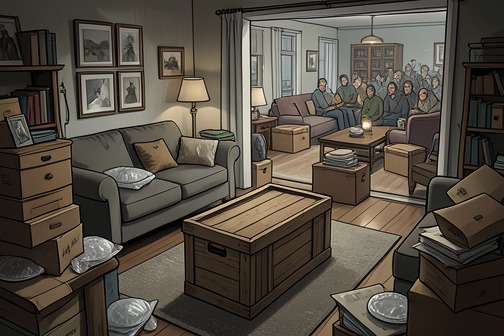
[Joanne Stuart](entity:character-recall-character-joanne-stuart-96aaade26f1c) and [Abbie](entity:character-recall-character-abbie-42aaeea09279)’s civil partnership dissolution is the immediate personal rupture behind Joanne’s move from their shared apartment. Only a fortnight after the partnership ended, the apartment was being sold and Joanne was preparing to leave, turning separation into both a practical upheaval and a renewed experience of grief.
## Circumstances and Separation
Abbie was eight months pregnant by a donor she had chosen for herself and was eager to receive her share of the apartment. A cash buyer offered the asking price, but needed Joanne to move out by the end of the month; completion could happen within ten days. The dissolution therefore coincided with an urgent division of their shared home, giving the end of the partnership immediate material consequences.
## The Move and Its New Setting
As Joanne packed, she placed bubble-wrapped plates in a crate and looked across a lounge crowded with packing cases. The room’s desolation recalled an earlier period when she had felt alone and abandoned, but she also recognized that circumstances were changing. A suitable apartment had come onto the market at [Salford Quays](entity:location-recall-location-salford-quays-5fa6c63c065e), close to her work and to [Agata Kowalski](entity:character-recall-character-agata-kowalski-fd7e75a74ae9), whose home was across the Huron Basin. Joanne regarded it as too early to move in with [Agata](entity:character-recall-character-agata-103135b06f69). She suspected Agata would have been willing, but understood her hesitation as a consequence of having been hurt before.
## Aftermath and Emotional Significance
The separation became a second grief for Joanne, following the trauma of her abduction in the Bluebell Hollow case. She had tried to address that earlier loss by acknowledging it, returning to work, taking up [Krav Maga](entity:concept-recall-concept-krav-maga-7114cd20d13c), and seeking new challenges with the [National Crime Agency](entity:organization-recall-organization-national-crime-a-73aa4ccb877b). Abbie’s departure nevertheless prodded her defences and tested her resilience anew. The partnership’s dissolution thus marks more than a change in domestic arrangements: it unsettles a recovery Joanne had worked to build, even as the move and her developing relationship with Agata point toward a different life.
Event 5
曼彻斯特竞技场爆炸案
The [Manchester Arena bombing](entity:event-recall-event-04a27ad1f4bd) is an off-page event whose aftermath helps define the conditions of the novel’s police investigation. It pulls detectives into counter-terrorism work while staffing shortages and public pressure constrain [Greater Manchester Police](entity:organization-recall-organization-greater-manchest-05348b3bc5a3), making the bombing’s institutional consequences a continuing force in the story rather than a separately depicted scene.
## Institutional Aftermath
[Helen Gates](entity:character-recall-character-helen-gates-27a1ff929f6f) explains that, following the bombing, the Chief Constable has had to transfer a large group of detectives to Serious and Organised Crime and Counter Terrorism Command. That redeployment leaves fewer investigators available for other cases. The [National Crime Agency](entity:organization-recall-organization-national-crime-a-73aa4ccb877b) agrees to cooperate with [Operation Alecto](entity:event-recall-event-operation-alecto-484ae5331b4a), which may have wider national significance, while the team is based at [Nexus House](entity:location-recall-location-nexus-house-6b85dd7c71a2) with Syndicate One. The bombing thus forms part of the operational background to the investigation and its cross-agency arrangements.
The pressure is not limited to transferred officers. [Gordon Holmes](entity:character-recall-character-gordon-holmes-5ee9c071ebfe) says recruitment to the Criminal Investigation Department has also declined, alongside the impact of cuts and the bombing’s aftermath. He fears that the loss of detectives will leave too few investigators to pursue serious offences effectively. His account presents the bombing as one factor in a broader institutional strain, rather than the sole cause of the police force’s diminished capacity.
## Public and Operational Pressure
The case unfolds under the prospect of intense press attention and political scrutiny. Gates warns that the Mayor and council leader will pressure the Chief Constable, who will in turn press her, while the force must also avoid a vigilante conflict and a return to the period associated with “[Gunchester](entity:expression-recall-expression-gunchester-d2cd7edc9db3).” The bombing’s aftermath therefore contributes to a setting in which major incidents compete for police attention and the handling of a high-profile inquiry carries public consequences.
Despite these constraints, [Jo Stuart](entity:character-recall-character-jo-stuart-5a4f22fe2dbd) structures the investigation around shared access to information. She uses a concise, laminated digest of the [Murder Investigation Manual](entity:rule-recall-rule-murder-investigation-man-5334bf950ea3) to guide the team’s review, and insists that information from the crime scene be made available to everyone rather than held by individual officers. This procedural emphasis contrasts with the scarcity around the team: investigators must coordinate carefully because personnel and time are under pressure.
## Consequences for the Investigation
At a meeting with senior officials, Jo reports an exhaustive list of people with possible grudges against either victim, but no names common to both lists. Investigators also have partial boot prints, a piece of fabric, and hours of passive media, including fixed-speed and ANPR camera footage, still to examine. These concrete leads require sustained investigative work at the same time that the force is stretched by other demands.
The novel also makes the procedural burden visible at the investigation’s end. Because a man dies during a police operation, the [Independent Police Complaints Commission](entity:organization-recall-organization-independent-poli-9f868f6d3fca) becomes involved, an internal review must be prepared, and a press release has to be agreed. Across the inquiry, the bombing’s aftermath supplies a persistent context of diverted resources and institutional scrutiny: it shapes the police capacity available to investigate, while the consequences of their own operation add a further layer of accountability.
Event 6
格奥尔基·马尔科夫遇刺案
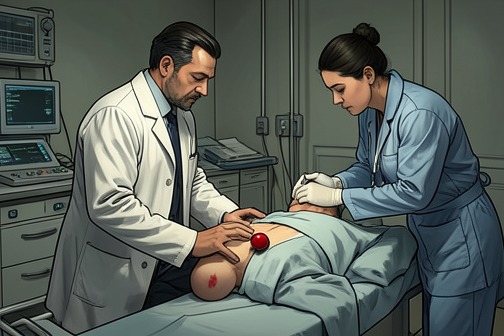
The [Georgi Markov assassination](entity:event-recall-event-georgi-markov-73ef48e4feb7) is invoked as a rare precedent for a poisoning carried out with a pellet: a tiny object whose danger was not apparent at first. Recounted during a discussion of an unfamiliar modus operandi, the case links a past political assassination to the present investigation through the distinctive method of ricin delivery.
## Recalling an Unfamiliar Method
[Sir James Flatman](entity:character-recall-character-sir-james-flatman-f4bf916639b0) explains that poisoning by pellet was new to him, though a colleague had encountered a similar case. [Jo Stuart](entity:character-recall-character-jo-stuart-5a4f22fe2dbd) recognizes the reference only after Flatman names Markov; she says she was one year old in 1978 and had to look the case up. The exchange establishes the assassination not as general background but as a specific precedent raised to make sense of an unusual method.
## The Pellet and Its Discovery
Flatman identifies Markov as a Bulgarian defector and recounts that his colleague, Dr Bernard Riley, treated him at the time. Neither the medical staff nor the police initially understood what had happened. The crucial clue was a tiny, pinhead-sized pellet embedded in Markov’s thigh. Markov had thought the small red mark on his leg was an insect bite, while the pellet was releasing ricin into his bloodstream.
## Death and Narrative Significance
Markov died four days later. The short interval between the unnoticed pellet and the fatal outcome gives the method its force in the conversation: an apparently minor mark concealed a poisoning that was difficult for both the victim and professionals to identify. The reference provides a historical point of comparison for the investigation’s own pellet poisoning, while underscoring how the weapon’s small size and concealed effect can delay recognition.
Event 7
Ricin attack series

The [Ricin attack series](entity:event-recall-event-ricin-attack-series-db096a0240b6) links a succession of attacks through an unusual weapon and a repeated choice of setting: poison-loaded pellets, presumed to contain ricin, used on golf courses. The method turns what initially appears to be a local investigation into a cross-force inquiry, while a later victim’s survival changes the stakes from identifying fatalities to acting quickly to preserve a life.
## Method and Emerging Pattern
Investigators identify the attacks by the combination of a pellet loaded with poison, thought to be ricin, and a golf course chosen as the scene. In discussion of the [Merseyside](entity:location-recall-location-merseyside-8d677721b423) killing, the method and location are both described as identical to the [Manchester](entity:location-recall-location-manchester-4236006a4a66) case. The recurrence makes a connection compelling to investigators, though they stress that it has yet to be confirmed.
The investigation also considers how the attacker might have developed the technique. One line of speculation is that the person responsible had studied the wax-sealed pellet used in the assassination of Markov and had experimented through trial and error, perhaps using simulated targets or animals. This is presented as a possible route to the method, not an established account of the attacker’s preparation. The unusual delivery technique is treated as a new dimension of ricin’s use in close-up attacks.
## Victims and Cross-Force Investigation
At the point when the Merseyside case is discussed, investigators have not established whether its victim and the Manchester victim were directly connected. They do know that both were involved in the same criminal enterprise, making it likely that they were at least aware of one another. That shared criminal context offers a possible link without yet identifying a common motive or perpetrator.
The Merseyside Force and the [Regional Organised Crime Unit](entity:organization-recall-organization-regional-organis-ad5728fc1c62) agree to handle the Merseyside end of the inquiry for the time being. A direct communications system connects the two investigations, turning the resemblance between cases into an operational link between the teams. The arrangement reflects both the apparent reach of the series and the need to coordinate across force boundaries while the relationship between the victims remains unsettled.
## Evidence and Uncertainty
The Manchester investigation has an extensive list of people who might have held a grudge against either victim, but no name appears on both lists. Investigators therefore have no single suspect emerging from the comparison. Their available material includes partial boot prints, a piece of fabric recovered at the Manchester scene, and hours of passive media, principally from fixed-speed and ANPR cameras. All three lines of work are still proceeding; the evidence is promising in quantity but has not yet resolved who carried out the attacks.
The series’ unusual poison does not immediately solve that problem. Although the ricin prompts questions about whether its distinctiveness should give investigators a lead, the evidence at this stage remains incomplete: the method can connect scenes, but it does not by itself establish the attacker’s identity or motive. The repeated pattern sharpens the inquiry even as its central questions remain open.
## Escalation and Antidote
A second fatality confirms that the pattern is not confined to the first Manchester death. Jo explains that the attack occurred the previous Sunday and that the victim died the day before the conversation. The method was identical, including the golf-course setting, but an important piece of evidence was lost: the victim removed the pellet and threw it away. The recurrence therefore strengthens the link between attacks while depriving investigators of the pellet itself in that case.
The series escalates again when [Nick Carter](entity:character-recall-character-nick-carter-8c8f36fe5263) calls with news of another victim. This time, the investigation’s immediate priority is treatment. Jo asks for a dose of the ricin antidote delivered that morning by [Porton Down](entity:location-recall-location-porton-down-c19d40a04916) to be sent to the [Manchester Royal Infirmary](entity:location-recall-location-manchester-royal-inf-7ec44a7f08e3). Nick has already contacted the hospital; the dose is couriered over and administered. Jo’s relief at having a surviving victim marks a decisive change in the inquiry: a live patient may offer a chance to learn more, while the antidote makes the threat one that emergency coordination can directly confront.
## Narrative Significance
The attacks acquire their identity through recurrence: a rare poison, a pellet, and golf courses in different jurisdictions. Each repeated detail supports comparison, but each case also exposes a limit—victims’ connections remain uncertain, the Manchester evidence yields no common suspect, and one victim’s discarded pellet cannot be examined. The narrative thus balances the force of a recognizable pattern against the slow, unresolved work of proving who is responsible.
The arrival of the antidote and the survival of a victim shift that pattern from retrospective investigation toward urgent intervention. The series is no longer represented only by deaths and traces left at crime scenes; it also includes a narrow opportunity to save someone and potentially speak with them. That change raises the stakes without prematurely resolving the mystery.
Event 8
Ronnie O’Neill murder

[Ronnie O’Neill murder](entity:event-recall-event-ronnie-o-neill-8614abd87760) is confirmed as a ricin poisoning when forensic analysis establishes that the pellet recovered from the seventh tee at [Worsley Golf Course](entity:location-recall-location-worsley-golf-course-d466148182e3) carried enough toxin to explain his death. The finding turns a suspicious death into a scientifically supported poisoning case, while a matching attack on [Merseyside](entity:location-recall-location-merseyside-8d677721b423) suggests a wider pattern whose connection remains unconfirmed.
## Background and Emerging Link
By the time investigators compare the [Manchester](entity:location-recall-location-manchester-4236006a4a66) case with a killing on Merseyside, the possible connection is compelling but not established. The two attacks share the same apparent method: a pellet loaded with poison, presumed to be ricin, and the same kind of setting, a golf course. The victims were involved in the same criminal enterprise and were therefore likely to have known of one another, though investigators had not established whether they were directly connected.
The distinction between resemblance and proof matters. Investigators describe the Merseyside case as apparently linked, but stop short of treating that link as confirmed. [Merseyside Police](entity:organization-recall-organization-merseyside-polic-4ea4eb01b1db) and the [Regional Organised Crime Unit](entity:organization-recall-organization-regional-organis-ad5728fc1c62) agree to handle the investigation on their side, while a direct communications system connects the two inquiries. The arrangement makes the parallel cases easier to compare without collapsing them into a single proven account.
## The Investigation in Manchester
The inquiry has an exhaustive list of people who might hold a grudge against either victim, but the names do not overlap. That absence limits the usefulness of a shared-motive theory: at this stage, no person appears on both lists as a common suspect. Investigators are also working through partial boot prints and a piece of fabric recovered from the Manchester crime scene, alongside hours of passive media, principally footage from fixed-speed and ANPR cameras.
These leads remain work in progress rather than a disclosed identification of the killer. When asked whether the unusual poison provides a lead, the evidence does not establish that it has yet produced a suspect. Instead, the investigation combines physical traces, recorded movements and the possibility of a connection to the Merseyside killing, with each line still requiring development.
## Forensic Confirmation
The decisive result comes from analysis of the pellet and Ronnie’s post-mortem findings. Asked whether the pellet could have contained enough ricin to account for the death of the person at whom it was fired, the forensic response is categorical: the post-mortem findings are consistent with ricin poisoning. Given Ronnie’s body weight, only a fraction of the amount of ricin the pellet was designed to transport would have been sufficient to explain his death.
The result establishes both the presence of the poison and the pellet’s capacity to deliver a fatal amount. [Jo Stuart](entity:character-recall-character-jo-stuart-5a4f22fe2dbd) reads the technical report and understands its central conclusion: the toxin would have broken down protein in Ronnie’s body and caused his death. The scientific language is dense, but its implication for the case is direct: the pellet is not merely unusual evidence at the scene; its payload accounts for the fatal poisoning.
## Confirmation and Consequences
Jo later tells [Nick Carter](entity:character-recall-character-nick-carter-8c8f36fe5263) that the pellet recovered from the seventh tee at Worsley contained ricin and that Ronnie died of ricin poisoning. She adds that Morris Grimshaw almost certainly died from it too, extending the significance of the forensic finding beyond Ronnie’s case while retaining a distinction in certainty: Ronnie’s poisoning is confirmed, whereas Grimshaw’s is described as almost certain.
The result also supports an existing investigative line. Nick points out that the team had begun contacting suppliers of castor oil seeds to identify people who made multiple purchases. His response treats that work as especially valuable in light of the ricin finding, although the evidence does not establish that it has yet identified the perpetrator. The murder’s significance therefore lies not in an immediate solution, but in the confirmation of a specific poison, the apparent recurrence of the same method, and the investigative connection drawn between Manchester and Merseyside.
Event 9
Attempted murder of Heather Rand

The attempted murder of [Heather Rand](entity:character-recall-character-heather-rand-bc577331f595) is the ricin-pellet attack that leaves her alive to identify the shootings as a connected series. Heather’s survival gives [Jo Stuart](entity:character-recall-character-jo-stuart-5a4f22fe2dbd)’s investigation its first living victim and a witness alert enough to recognize the pattern; later, as Jo struggles with [Darren Clements](entity:character-recall-character-darren-clements-84b771bbc219)’s death, the attack remains part of the chain of events that brought the investigation to its fatal conclusion.
## The attack
Heather is at Ye Olde Cock Inn after a demanding day spent helping care for her granddaughter, completing errands, and preparing dinner. The brief respite is interrupted when a pellet strikes her. The impact knocks her down, and her dog circles her, barking. The birds she had been watching fly away as the incident unfolds.
The evidence later establishes how the pellet reached her: it passed through her parka and wool sweater before lodging in her upper arm. The shooting also caused Heather to fall and dislocate her other shoulder. Despite the injury, she made it back to her car and drove herself to hospital, turning a violent attack into the first opportunity for the police to speak with someone who had survived one.
## A living witness
At the hospital, Jo is told that the pellet is bloody and flattened, sealed in a small plastic pot inside a clear evidence bag marked with biohazard tape. The medical team has already administered the ricin antidote delivered from [Porton Down](entity:location-recall-location-porton-down-c19d40a04916) that morning. Jo’s relief is immediate: the investigation has, at last, a surviving victim to question.
Heather recognizes that her case may be connected to the recent air-rifle shootings. She points out that two people have died after such attacks in less than a week, one in [Manchester](entity:location-recall-location-manchester-4236006a4a66) and one in [Southport](entity:location-recall-location-southport-aa651e8627ae), and asks whether her own shooting is more than coincidence. Jo tells her privately that Heather is actually the fourth person shot: another attack has taken place that day, and Heather is the only survivor. The revelation shifts her understanding of the incident from an isolated assault to part of a continuing series. [Nick Carter](entity:character-recall-character-nick-carter-8c8f36fe5263) describes the unknown attacker as potentially a spree killer or a serial killer, depending on how the intervals between attacks are interpreted.
## Investigation and consequences
Heather’s survival changes the practical shape of the inquiry. Her injuries require urgent treatment, but the antidote reaches her in time; her account also gives the police a direct human link between the shootings. The case becomes not only a sequence of deaths and recovered pellets but an investigation with a living witness capable of recognizing its pattern.
Later, Jo’s account of post-traumatic stress after Mel’s death makes clear how grief and sudden reminders can persist well beyond the original crisis. The novel does not equate Jo’s trauma with Heather’s attack; rather, it places the shooting within an investigation whose consequences extend into the lives of its participants. When the police establish that Darren Clements could not have fired the earlier shots, Jo chooses not to expose the refuge he has made for himself, questioning what purpose there would be in destroying it after everything he has already suffered. The attack’s wider consequences therefore include the moral pressures of pursuing the case as well as the immediate danger to its victims.
## Jo’s guilt and the attack’s later meaning
The consequences of the investigation culminate in Jo witnessing Clements’s fatal motorway collision. She switches off her radio, struggles to steady herself, and retches. [Gordon Holmes](entity:character-recall-character-gordon-holmes-5ee9c071ebfe) tells her that Clements’s death was not her fault; Nick reminds her that Clements had killed three people and wounded another, and that Jo had prevented him from killing [Henry Mwamba](entity:character-recall-character-henry-mwamba-ada10b46c259). Yet those reassurances do not undo Jo’s belief that, without her pursuit, Clements would still be alive. She remains haunted by his final expression and by the thought that he was trying to escape when he turned toward the shouts.
The attack on Heather is significant in this arc because it establishes the stakes that make the pursuit necessary, while also belonging to the sequence of decisions and events Jo later revisits with guilt. At home, when [Agata Kowalski](entity:character-recall-character-agata-kowalski-fd7e75a74ae9) asks why she does the job, Jo answers that at times she wonders the same. [Agata](entity:character-recall-character-agata-103135b06f69) points her back to the people the work protects, including Heather, [Melissa Walsh](entity:character-recall-character-melissa-walsh-4644f6d97afa), Françoise Mwamba, and [Sarah Weston](entity:character-recall-character-sarah-weston-76c2a57be2a5). Heather’s survival thus stands for more than a breakthrough in the case: it is one of the reasons Jo’s work matters, even when the cost of carrying it out remains difficult for her to bear.
Event 10
Melissa Walsh kidnapping
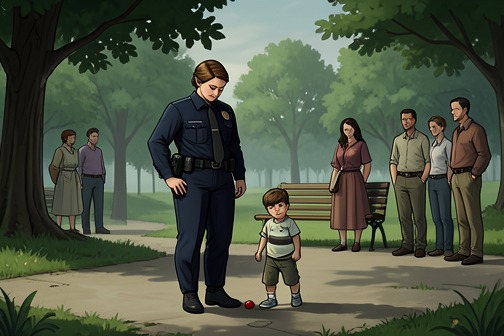
[Melissa Walsh](entity:character-recall-character-melissa-walsh-4644f6d97afa)’s kidnapping is the crisis that entangles the search for a missing schoolgirl with [Operation Alecto](entity:event-recall-event-operation-alecto-484ae5331b4a)’s investigation of the ricin attacks. Investigators suspect that people close to the first victim took [Melissa](entity:character-recall-character-melissa-64b753949b14) because they believed her father was responsible for his death, or knew something about it; the abduction thus threatens to turn a murder inquiry into wider gang violence. Her rescue ends her immediate captivity, but not its effects, and the identity of those who arranged the kidnapping remains unresolved in the available account.
## Background and suspected connection
When senior officials ask whether Melissa’s disappearance is linked to Operation Alecto, [Jo Stuart](entity:character-recall-character-jo-stuart-5a4f22fe2dbd) describes the connection as tangential. The team’s working belief is that her captors are close to the first victim and suspect that Melissa’s father was responsible for his death, or at least knows something about it. The causal link is therefore an investigative theory, not a confirmed account of the perpetrators’ motive.
The possibility of retaliation makes the kidnapping consequential beyond the Walsh family. The Chief Constable fears that news of the incident could leave gang leaders across the region anticipating further attacks and considering pre-emptive action. [Helen Gates](entity:character-recall-character-helen-gates-27a1ff929f6f) says [Challenger](entity:organization-recall-organization-challenger-1cf7ba2580f4) and [Titan](entity:organization-recall-organization-titan-2e0d16c8fc39) are involved and will act if there is any sign of escalation. The missing-child inquiry is consequently treated both as a rescue operation and as a potential flashpoint in a broader conflict.
## The investigation
The search proceeds alongside the murder investigation, with substantial demands on already limited police resources. At a briefing, Jo Stuart draws on a digest of the [Murder Investigation Manual](entity:rule-recall-rule-murder-investigation-man-5334bf950ea3) and its checklist of investigative strategy: the team must account for the crime scene, forensic work, and tissue samples taken at hospital. She then insists that information should be shared across roles rather than reserved for individual specialists. By having the crime-scene update presented to the whole team, she argues that any member might notice the missing piece; on Operation Alecto, there will be no prima donnas, including herself.
The case develops through evidence that is useful but inconclusive. Jo tells the Mayor and Chief Constable that investigators have compiled separate lists of people who might hold a grudge against either victim, but no name appears on both lists. They also have partial boot prints, a piece of fabric from the [Manchester](entity:location-recall-location-manchester-4236006a4a66) crime scene, and hours of passive media to examine, especially from fixed-speed and ANPR cameras. These lines of inquiry do not yet identify a suspect, and the unusual presence of ricin is not presented as a solution to the kidnapping.
A burned-out vehicle matching one of the suspected vans is found on waste ground in [Wythenshawe](entity:location-recall-location-wythenshawe-5c1a291e68aa). There is no sign of Melissa or her captors. Investigators seek CCTV that might show a vehicle change and try to identify the van, which they suspect was stolen specifically for the job. Later information establishes that the van was stolen two days earlier from a builder’s yard in [Trafford](entity:location-recall-location-trafford-3019deb006c4). The firm’s CCTV shows two hooded teenagers, one thought to be female, but the image quality is poor; they had been dropped off by car in a neighbouring street. The evidence gives the investigators a route to reconstructing the abduction without yet revealing who commissioned it.
The operation is managed with attention to both evidence and risk. During one initial search, Jo reports that no suspect has been found and that dog handlers detected no weapons, drugs, or the substance under investigation. She nevertheless prepares to send in a biohazard Forensics team, despite a question about whether the dogs’ search makes that necessary. The exchange shows the investigation balancing procedural caution against the pressure to locate Melissa and establish what has happened.
## Melissa in captivity
The account of the kidnapping is also told through Melissa’s restricted knowledge of her surroundings. Bound and gagged, with her inhaler no longer available, she fears that her breathing may worsen and that she may suffer an asthma attack. She cannot establish how long she has been held or even where she is. Her captors give her food and water, but do not respond when she tries to communicate her needs. The loss of reliable time and contact makes captivity a condition of uncertainty as much as physical confinement.
Melissa tries to preserve clues for a future account to the police. She remembers the route into the building through details of its hallway and the people who carried her upstairs, and takes comfort in believing that the police will value what she has noticed. She also has to cope with being denied control over ordinary bodily needs. The captors make her use a metal bucket and later leave her unable to reach it. The episode ends with her crying, a stark contrast to her effort to remain observant and imagine what she might tell investigators.
As the captivity continues, she turns sounds and patterns into a rough map. An owl’s call suggests a countryside location outside the city; planes overhead suggest an airport nearby. She counts the intervals between aircraft, noticing that they come frequently during parts of the day and stop at night. From the voices and glimpses she distinguishes three male captors, giving two of them private nicknames: [Gollum](entity:character-recall-character-gollum-cfb88b61d1af) for the tall, thin man with a high-pitched voice, and [The Boxer](entity:character-recall-character-the-boxer-b65c5efd0482) for the shorter, broad-built man who speaks to her in a Manchester accent. These deductions make her a careful observer, but they cannot tell her where she is or when help will come.
Once the hood is removed, Melissa can see again, but greater access to her surroundings does not bring relief. Light and a dog barking whenever planes pass disrupt her attempts to sleep. Her physical discomfort and isolation accompany a deeper collapse in how she understands herself. She stops directing her anger at her father and his associates for failing to rescue her, and at her mother for failing to love her. Instead, she turns blame inward, recalling that her parents had treated her Common Entrance result as a disappointment: it was sufficient for entry to a private school, but not enough to persuade them that the fees were worthwhile. She comes to believe she was never worthy or lovable and concludes that her death might be best for everyone. The kidnapping’s danger is therefore not confined to the threat of physical harm; it also intensifies Melissa’s sense of abandonment and self-blame.
## Rescue and aftermath
Melissa’s rescue comes when she acts during the confrontation in the woods. As the armed suspect inches towards cover, police order him to stand still. Officers cannot fire while his pistol is trained on the girl. Melissa bites his hand; he releases her, and she runs, stumbles against a tree, and falls. Jo Stuart races up the bank and wraps her arms around Melissa. The action breaks the captor’s control long enough for Melissa to escape, although the armed suspect remains close and the officers continue ordering him to drop his weapon.
Jo later explains that Melissa’s failure to walk towards a road and flag down a car should not be mistaken for a simple choice. After being held against her will, isolated, frightened, and disoriented, she may have thought that staying in the open would make her easier for rescuers to find, or that she was safer where she was. Jo also allows that the captors may have warned her not to move. The uncertainty matters: the rescue is not treated as proof that Melissa could have secured her own safety by choosing a more obvious route.
Afterward, Melissa has her first session with a specially trained child counsellor. Jo reports that she was not physically harmed or sexually abused, but emphasizes that her mental and emotional recovery will take a long time and may never be complete. Melissa’s mother plans to take her to Disneyworld the following week, against professional advice; Jo thinks returning to school and her friends would be better. Melissa is also not speaking to her father and blames him for the situation, leaving their relationship altered by the kidnapping.
The identity of the organizers remains a suspicion rather than a resolution. Jo considers [Ronnie O’Neill](entity:character-recall-character-ronnie-o-neill-8f82999888b7) the likeliest person behind the abduction and reads Steve Yates’s disappearance as too coincidental to dismiss. She believes he probably arranged the kidnapping through burner phones. In her account, the captors had no further reason to hold Melissa once [Darren Clements](entity:character-recall-character-darren-clements-84b771bbc219) became the police’s prime suspect, which would also explain why Yates later appeared at [Jason O’Neill](entity:character-recall-character-jason-o-neill-dd0eff31da96)’s home. These are Jo’s deductions, not a confirmed finding that closes the case.
## Significance
The kidnapping tests the investigation’s ability to keep a vulnerable missing child at its centre while managing the wider political danger of retaliatory violence. The procedure Jo imposes—shared information, systematic evidence review, and continued forensic work—stands against the case’s uncertainties: poor-quality images, a burned vehicle, incomplete traces, and suspects who remain under suspicion rather than proven guilty.
Melissa’s point of view gives those uncertainties an intimate measure. She watches, listens, and tries to turn fragments into evidence, but her careful attention cannot remove her dependence on others. Rescue restores her freedom of movement; it does not restore trust, erase self-blame, or settle her relationship with her parents. The kidnapping therefore ends as an immediate emergency while remaining an open investigation and an ongoing psychological rupture.
Event 11
Elaine Clements’s death and inquest
[Elaine Clements’s death and inquest](entity:event-recall-event-elaine-clements-305a91780b16) establish the personal wound behind [James Clements](entity:character-recall-character-james-clements-639d96789386)’s later hostility toward coroner [Heather Rand](entity:character-recall-character-heather-rand-bc577331f595): a fifteen-year-old girl died after taking cocaine, and the inquest classified her death as misadventure rather than assigning responsibility to a supplier or dealer. The unanswered questions did not remain abstract for her father. His grief hardened into anger, and the official limits of what the inquest could determine became, for him, a reason to keep pursuing the case.
## Death and Inquest
Elaine was found dead in her bedroom by her father. The post-mortem attributed her death to an overdose, and the inquest recorded misadventure: death from a self-administered opiate, in essence drug misuse. The drug was cocaine. The distinction between the official finding and James’s understanding of his daughter’s death is central to the episode. The inquest could describe what she had taken and how she had died, but it did not identify who had supplied the drug or establish the precise circumstances that made the dose fatal.
The inquest took place in January 2011, six years before the conversation in which its history resurfaced. That date also connected it to another strand of the investigation: [Nick Carter](entity:character-recall-character-nick-carter-8c8f36fe5263) observed that it was the same year [Ronnie O’Neill](entity:character-recall-character-ronnie-o-neill-8f82999888b7) was imprisoned. [Jo Stuart](entity:character-recall-character-jo-stuart-5a4f22fe2dbd) reacted with a warning look, signalling the potentially charged significance of making that connection. The parallel does not itself establish a link between the cases, but it places Elaine’s death and its aftermath within the wider chronology Jo and Carter are examining.
## Why the Verdict Could Not Answer Everything
Jo Stuart’s review of the inquest materials explains why misadventure was treated as inevitable. Elaine had taken a self-administered Class A drug, and neither the supplier nor the dealer had been identified. The evidence could not determine whether the amount she took or the cocaine’s purity had caused the fatal outcome. Nor could forensic analysis produce a reliable estimate of the dose: Elaine went to her room at 9:30 the night before her death, and her father did not find her until 8:00 the next morning. With the time of ingestion unknown, the cocaine’s one-hour half-life could not resolve how much she had taken.
Elaine was new to drug-taking, a further complication in interpreting the dose. Jo explains that an inexperienced user’s body could react more extremely than the body of a habitual user. The investigation therefore faced several connected uncertainties—when Elaine took the cocaine, how much she took, how pure it was, and how her lack of experience affected her response. Those uncertainties help explain the limits of the inquest’s conclusion; they do not settle the moral question that troubled her father.
## James Clements’s Grief and Anger
James was distraught and angry when the verdict was read. He made wild threats in court, had to be restrained, and was led away. The outburst was followed not by acceptance but by sustained harassment: he sent vile anonymous letters to Heather Rand’s office and home. An application for a restraining order was made on Heather’s behalf, yet she did not report him to the police. She felt sorry for him, a response her colleague remembered as typical of Heather’s softness toward others, even when that softness left her exposed to abuse.
Years later, James described the way Elaine’s death had remade his everyday life. Finding her lying across the bed turned his life upside down. He could not sleep without vivid, horrible dreams; he was continually angry and on edge. Unlike his wife, who lost her appetite, he felt a powerful need to gorge himself. He believed that unless he discovered why Elaine had died, he would go mad. His account gives the inquest’s aftermath a continuing duration: the hearing ended, but the loss persisted as sleeplessness, agitation, altered eating, and an effort to force an answer from a case that had not supplied one.
## From Private Loss to a Wider Accusation
James’s anger widened beyond the hearing and Heather’s verdict. He cited 139 deaths from cocaine alone in the year he was discussing and said the death rate was rising year by year. He had been told that increased cocaine purity flooding the market was responsible; in his view, even people accustomed to taking the drug might not realize that a familiar dose could become fatal. Elaine, experimenting for the first time, could not know what she was taking or how it would affect her. James’s complaint thus joined his daughter’s particular death to a wider danger, while insisting on the vulnerability of someone without experience of the drug.
He also described trying to locate a dealer and being laughed at. That encounter intensified the contrast between the consequences borne by the bereaved family and the apparent indifference of those who sold cocaine. The inquest’s evidentiary limits, the unidentified supplier and dealer, and the absence of a reliable dose estimate left James with no account that could make the death feel intelligible or just. His continuing pursuit of an explanation became part of the tragedy’s aftermath: a search driven by real unanswered questions, but one that could not undo Elaine’s death.
Event 12
Mel Teesdale’s fatal collision and inquest

[Mel Teesdale’s fatal collision and inquest](entity:event-recall-event-mel-teesdale-1758c49101e2) are recalled as the unresolved loss that shaped [Aaron Teesdale](entity:character-recall-character-aaron-teesdale-84be026c66cb)’s grievance against former coroner [Heather Rand](entity:character-recall-character-heather-rand-bc577331f595). In spring 2011, Mel was killed outside her children’s primary school by a pensioner who had been driving despite a condition that might have impaired him. A jury returned an accidental-death verdict; years later, Rand acknowledged that a finding of causing death by careless driving might have been more appropriate. The case surfaced during a separate murder investigation because investigators were examining people who might hold a grudge, but the connection remained a possible motive, not proof that Aaron was responsible for the later attacks.
## The collision and inquest
The collision took place outside Mel’s children’s primary school in spring 2011. The driver, described as a pensioner, handed himself in to police that same afternoon. Mel’s husband, Aaron Teesdale, was serving in Helmand and was flown home on compassionate leave. He was deeply distressed, had to be restrained in court, and threatened Rand and witnesses outside. He also made an official complaint, which came to nothing.
The inquest turned on whether the driver had knowingly driven while suffering from a physical condition that significantly and dangerously impaired his ability to drive. The driver’s knowledge was decisive: as Rand later explained, the case hinged on the meaning of “knowingly.” She called a jury because the matter had attracted significant press attention and had become a public-interest case. Although she attempted to direct the jury, it found in the driver’s favour and returned an accidental-death verdict.
## Disputed verdict and lasting grievance
Years later, Rand told investigators that she regretted her part in the inquest’s outcome. She believed the finding should at least have been causing death by careless driving. Her account was not that the jury’s decision had simply surprised her: she had made the fateful decision to put the case to a jury, and the jury reached a verdict in the driver’s favour despite her directions.
Rand offered a possible explanation for that result. In her experience, juries in both coroner’s and criminal courts could be reluctant to convict in negligent-manslaughter cases if they believed the likely punishment would be disproportionate. Although the inquest was not itself a criminal trial, she thought jurors might have feared that a finding of causing death by careless driving would prompt police and the [Crown Prosecution Service](entity:organization-recall-organization-crown-prosecutio-9051196db82b) to reconsider the case and bring the driver before a criminal court.
The verdict did not settle the family’s sense of what had happened. Rand said that when a family is left feeling profoundly wronged, its pain and bitterness do not fade and may deepen. Her remorse and explanation gave investigators a clearer account of why the case could still matter years later, while also underlining that the inquest had not established the more serious conclusions Aaron wanted.
## Aaron Teesdale’s interpretation
Aaron’s anger rested on a different, more categorical account. When questioned about the inquest, he accused Rand of knowing that the collision was not simply an accident. He asserted that the driver had lied on his Driver and Vehicle Licensing Agency self-disclosure form, to his insurer, to the police, and in court, and argued that Rand’s summing-up effectively acknowledged this. He believed she should have directed the jury to return a manslaughter verdict.
Aaron therefore rejected the accidental-death finding as an inadequate description of Mel’s death. He saw the driver’s alleged prior knowledge and dishonesty as evidence that the death was not an unavoidable mishap. His conviction that his wife had been wronged supplied a powerful personal grievance, but it remained his interpretation of the case, not a finding made by the inquest. The distinction matters: the narrative presents both the official verdict and the bereaved husband’s rejection of it without treating them as equivalent evidence.
## Reappearance in the ricin investigation
The old inquest returned to the story when former coroner Heather Rand was herself attacked with a ricin-coated pellet. Investigators asked whether a past grievance could explain the attack. Rand identified Aaron as someone who might fit that possibility, recalling a newspaper interview from a couple of years earlier in which he had described the inquest as a terrible miscarriage of justice. She had not heard from him directly since an injunction ended his contact with her.
The possible motive was not, however, a connection to the other victims. [Jo Stuart](entity:character-recall-character-jo-stuart-5a4f22fe2dbd) cautioned against settling on Aaron: his grievance against Rand did not link him to the other people targeted. [Nick Carter](entity:character-recall-character-nick-carter-8c8f36fe5263) speculated about Aaron’s military service, but that was speculation, not evidence of his involvement. At that stage, investigators had a list of people who might resent either victim, but no name appeared on both lists. They also had partial boot prints, a piece of fabric from the [Manchester](entity:location-recall-location-manchester-4236006a4a66) crime scene, and extensive passive media to examine. The recalled inquest thus contributed a plausible lead while leaving the larger case unresolved.
## Narrative significance
The case gives the investigation a history of loss that cannot be reduced to a suspect list. In the earlier inquest, the key question was whether the driver knowingly drove while impaired; in the later investigation, the unresolved verdict mattered because Aaron was thought to have a continuing grievance against Rand. That sequence makes the inquest relevant without turning suspicion into certainty.
Its significance also lies in the gap between a legal outcome and a family’s understanding of justice. The jury’s verdict formally concluded the inquest, but it did not persuade Aaron that Mel’s death had been properly named or accounted for. Rand’s later remorse acknowledges that the decision had consequences beyond the courtroom, even as her explanation preserves the uncertainty around why the jury ruled as it did. For the murder investigation, the old case was both a possible motive and a reminder that a painful grievance alone could not establish who carried out a new attack.
Event 13
Georgi Markov assassination

The [Georgi Markov assassination](entity:event-recall-event-georgi-markov-73ef48e4feb7) serves as a historical point of comparison in the investigation of ricin-laced pellets. The account describes a KGB-designed poison-tipped umbrella and a pinhead-sized pellet, giving investigators a known method against which to examine a recovered projectile—without establishing that the current attacks are political or that the killer’s method was copied directly.
## Historical Method
In a discussion of how ricin might be obtained, [Jo Stuart](entity:character-recall-character-jo-stuart-5a4f22fe2dbd) raises the assassination of Bulgarian defector Georgi Markov as an example associated with access to the poison through a state laboratory. The specialist agrees that the assassin’s poison-tipped umbrella was designed for him by the KGB and says it is a reasonable assumption that the organization also supplied the ricin. The exchange presents this as an account of the Markov case, not proof that the present investigation has a comparable political dimension.
The method’s small delivery device gives the historical example its specific relevance. Jo asks whether the killer under investigation copied the idea of delivering poison by pellet from the Markov case. The specialist leaves that question for the detectives to establish, while acknowledging that the comparison seems plausible.
## Pellet and Forensic Comparison
The specialist describes Markov’s pellet as pinhead-sized and made from an alloy of platinum and iridium. It had holes drilled to a depth of 0.016 inches—too small to see with the naked eye—and contained ricin in powder form. Wax sealed the powder and was designed to dissolve under the skin, releasing the toxin. These details distinguish the historical device from a generic poison delivery: its material, perforations, payload and dissolving seal formed a particular mechanism.
The comparison is brought into the present investigation through photographs of the pellet sent for examination. Once its dirt had been removed and the image magnified, nine holes were visible in the head protruding above its flattened skirt; the holes were described as roughly the size of a biro tip. The investigators therefore had a physical object to compare with the historical account, but the conversation does not establish that the two pellets were identical or that the current suspect had copied Markov’s device.
## Significance to the Investigation
The Markov precedent narrows attention to a possible delivery technique while keeping method and motive separate. Jo explicitly notes that nothing then suggested her investigation concerned a political assassination. The historical case can therefore inform a line of inquiry without deciding what kind of crime the contemporary attacks represent. Its role is evidential and comparative: a known assassination method offers a hypothesis to test against the recovered pellet, not a conclusion about who acted or why.
Event 14
Operation Alecto
[Operation Alecto](entity:event-recall-event-operation-alecto-484ae5331b4a) is the investigation [Jo Stuart](entity:character-recall-character-jo-stuart-5a4f22fe2dbd) is seconded to lead after the murder of [Ronnie O’Neill](entity:character-recall-character-ronnie-o-neill-8f82999888b7). As the case expands into a series of ricin-pellet attacks and the disappearance of [Melissa Walsh](entity:character-recall-character-melissa-walsh-4644f6d97afa), it becomes both a search for a killer and a test of how police teams share evidence, manage uncertainty, and account for the consequences of their decisions.
## Commission and investigative method
[Helen Gates](entity:character-recall-character-helen-gates-27a1ff929f6f) tells Jo that Jo’s Director of Investigations has agreed to second her to [Greater Manchester Police](entity:organization-recall-organization-greater-manchest-05348b3bc5a3) to head the murder investigation. [Gordon Holmes](entity:character-recall-character-gordon-holmes-5ee9c071ebfe) is comfortable with the arrangement because he is taking over an apparently unrelated series of shootings, though Gates voices the hope that the cases really are unconnected. The new command structure thus begins under the shadow of a possible wider connection, not a settled understanding of the threat.
Jo approaches the work through formal investigative procedure. A laminated digest of the [Murder Investigation Manual](entity:rule-recall-rule-murder-investigation-man-5334bf950ea3) gives her a practical checklist of investigative strategy, which she reviews with [Nick Carter](entity:character-recall-character-nick-carter-8c8f36fe5263). She identifies the crime scene, forensic examination, hospital tissue samples, and the post-mortem as immediate strands of work. The manual is not a solution in itself: it makes omissions visible and helps the team account for the steps on which a later review, or a defence challenge, could turn.
Her management principle is equally explicit. Jo asks for a crime-scene update to be shared with the whole team rather than relayed only through her, so officers in different roles can consider the same information and perhaps notice a missing piece. She rejects prima donnas, including herself, and Nick quietly supports the approach. Operation Alecto is therefore presented not simply as a detective’s individual pursuit, but as a collective process in which access to information is part of the method.
## Leads, evidence, and uncertainty
The investigation’s evidence base remains incomplete. Jo reports to senior officials that the team has compiled extensive lists of people who might have held grudges against either of the first two victims, but the names do not overlap. Investigators also have partial boot prints, a piece of fabric from the [Manchester](entity:location-recall-location-manchester-4236006a4a66) crime scene, and hours of passive media to examine, principally from fixed-speed and automatic number-plate recognition cameras. Each item creates work rather than certainty: traces need comparison, and recordings must be reviewed before they can establish a common pattern.
After further attacks, the team continues to look for connections across crime scenes. Jo says that a significant person of interest has effectively been eliminated, a useful safeguard against the later allegation that investigators were careless. The remaining trace evidence includes two pellets and footprints that cannot yet be matched to anyone. Nick considers common vehicle sightings near multiple scenes the best available avenue, with teams reviewing the victims’ locations and [Merseyside Police](entity:organization-recall-organization-merseyside-polic-4ea4eb01b1db) undertaking comparable work for its victim. The distinction between a lead and proof stays central: a promising line of enquiry does not yet identify a suspect.
The ricin and the apparent series draw public attention, but they do not immediately resolve the case. Media questions focus on why no one has been arrested, how little information has been released, whether a random attacker is at large, whether counter-terrorism officers are involved, and how the public can protect itself. The same coverage raises rumours that Melissa Walsh’s abduction is connected to the shootings. In this way, the inquiry’s uncertainty becomes a public problem as well as an operational one, while speculation threatens to collapse separate questions into a single explanation before the evidence can do so.
## The abduction and the expanding stakes
[Melissa](entity:character-recall-character-melissa-64b753949b14)’s disappearance makes the investigation’s stakes immediate and personal. When Jo asks whether there is news, she is told that people are chasing shadows: either nobody knows anything, or those who do are too frightened to speak. The lack of information does not mean the search is inactive, but it shows how fear can obstruct the ordinary gathering of intelligence.
Jo also tries to use relationships around the O’Neill family to generate help. When [Sheila O’Neill](entity:character-recall-character-sheila-o-neill-24b1adb886d6) urges her son Jason to help bring the missing child back, Jo reinforces that appeal. Jason denies involvement and says he cannot believe Steve Yates is involved either, but agrees to put the word out and find out what he can. The exchange produces a limited promise of assistance, not confirmation of what Jason or Steve knows; the investigation must work with that distinction rather than treating a family appeal as a verified lead.
As the pressure increases, Jo recognizes that she may know who the next victims could be. She admits that she would never forgive herself if [Darren Clements](entity:character-recall-character-darren-clements-84b771bbc219) reached them first. The thought gives the case a new urgency: the task is no longer only to reconstruct past attacks or find Melissa, but to prevent a further attack on people the team believes may be at risk. Concern about responsibility becomes part of the operation’s emotional and practical burden.
## Search operations and accountability
The operation’s search work is cautious about what negative results can establish. After initial searches find no sign of the suspect, Jo reports that the dog handlers have detected no weapons, drugs, or the specific substance under investigation. She nevertheless prepares to send in a biohazard forensic team, despite a question from Gold Command about whether dogs have already searched the area. The decision registers a tension between efficiency and the need to address a suspected hazardous substance through specialist examination; a negative canine search is not treated as a complete forensic clearance.
A search of the suspect’s room likewise turns on small, concrete absences. Jo looks for a Kindle with a red cover. It is not there, and when the searchers lift the mattress and find nothing else, she concludes that the suspect has taken everything. The room yields no discovery that advances the immediate search; its value lies in confirming how little remains to be recovered from that location.
After the hunt for Darren Clements ends in a fatal police operation, the investigation’s work shifts into review. The [Independent Police Complaints Commission](entity:organization-recall-organization-independent-poli-9f868f6d3fca) is already involved because a man has died during police activity. An internal review must also be prepared, alongside the more immediate agreement of a press release. Operation Alecto thus produces not only an investigative record but an accountability process: the force must examine what happened and communicate publicly about it.
## Outcome and narrative significance
The case reaches a public climax in the fatal end of the hunt for Darren Clements, whom news coverage dubs the Poison Pellet Perpetrator. The label compresses a complex investigation into a memorable media phrase, while the operation’s actual record is made up of checklists, incomplete traces, cross-scene comparisons, searches, communications, and decisions under uncertainty. The contrast helps explain why public demands for a quick answer sit uneasily beside the slower work needed to establish one.
The aftermath does not offer Jo uncomplicated relief. At the first debriefing, her attention is divided between the formal consequences of the operation and a message from [Agata](entity:character-recall-character-agata-103135b06f69), whom she cannot answer while the meeting is under way. The case has required her to lead, protect possible future victims, and act within a process that will itself be examined. Operation Alecto’s significance lies in that double movement: it pursues the person responsible for the attacks while exposing the procedural and human costs that remain after the immediate danger has ended.
Event 15
Darren Clements’s poison-pellet attacks
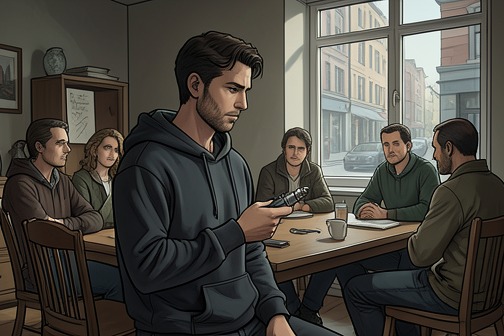
[Darren Clements’s poison-pellet attacks](entity:event-recall-event-6e8e95cc8cb5) are a connected series of shootings driven by a grievance over his sister’s death and carried out with a pellet-firing weapon. As the investigation joins the attacks to Clements, the case changes from a search for an unknown shooter into a race against a list of further intended victims. Its consequences extend beyond those directly targeted: the evidence exposes the breadth of the threat, while Clements’s death leaves [Jo Stuart](entity:character-recall-character-jo-stuart-5a4f22fe2dbd) struggling with the way the pursuit ended.
## Causes and Investigation
The attacks are connected to Clements’s blame for his sister’s death. Jo Stuart reasons that if he has been systematically working through people he holds responsible, either directly or indirectly, then his list may contain other names. The prospect of having alerted him to the investigation raises the urgency: he might accelerate his mission before police can stop him. [Sarah Weston](entity:character-recall-character-sarah-weston-76c2a57be2a5) sees the danger in that combination of grief and a powerful sense of injustice, while questioning whether the son rather than the father is responsible.
The investigation tests what kind of weapon could have been used. Firearms forensics report that pellets could in principle be fired from a long rifle using powder-activated nail-gun blanks, but the recovered pellets show neither rifling marks nor gunpowder residue. The sound would also have been more noticeable, even with a suppressor. The forensic assessment therefore points instead to a standard air rifle or a target air pistol. This narrows the explanation of the attacks without, at that stage, identifying the weapon conclusively.
## Targets and Escalation
The clearest record of the campaign is a handwritten list Jo finds in Clements’s notebook. Its first four names have been crossed out: O’Neill, Grimshaw, Dewlay, and Rand. The list marks different outcomes—three victims are dead and one is recovering—and makes the attacks legible as a sequence rather than isolated incidents. Three further names, apparently added later, remain uncrossed: ACC [Helen Gates](entity:character-recall-character-helen-gates-27a1ff929f6f), DI [Joanne Stuart](entity:character-recall-character-joanne-stuart-96aaade26f1c), and Eric Manson. The document turns the investigation’s fear of additional victims into a concrete threat, and places Jo herself among those named.
The list’s additions make the campaign’s escalation visible. Its later entries indicate that Clements’s intended targets extend beyond the four people already attacked, while the concern that police intervention may hasten his actions gives the discovery immediate stakes. The evidence supports a pattern of planned targeting, but does not establish in this account what prompted each individual name to be added or what Clements intended to do to everyone on the list.
## Weapon and Identification
The inquiry also follows the possibility that Clements could be placed at the scenes. Jo and her colleagues check his alibi with the stable owner and the grooms who are available. Their findings make it clear that he could not have fired the shots unless he had access to a helicopter. Jo nevertheless gives the owner the impression that she believes the case is one of mistaken identity. She wants to preserve the refuge Clements has made for himself, believing that he has already suffered enough. Her choice reflects a tension between the investigation’s need to test a suspect and her reluctance to destroy the place he has built as a retreat.
Later evidence confirms that Clements had joined a gun club using [Jordan Springer](entity:character-recall-character-jordan-springer-144be91d38fc)’s name shortly after his father left. He bought the air rifle through the club. The rifle used in the attacks is eventually found in a homemade rack beneath the workbench in a garage he was renting. This discovery connects the concealed weapon to the earlier forensic conclusion and supplies a concrete link between Clements and the campaign. The stated trigger for his move toward the gun club is his father’s departure; the evidence does not describe that as an immediate cause of the attacks, but as part of the sequence leading to the weapon’s acquisition.
## Consequences and Aftermath
[Heather Rand](entity:character-recall-character-heather-rand-bc577331f595) survives and is given the all-clear at hospital, although doctors want her to remain there for several days as a precaution. Her survival matters both as an outcome of the attacks and to the investigation’s assessment of Clements: Sarah Weston observes that learning at least one victim had survived could further affect him. The evidence does not establish how he responds to that news, but it underscores why the surviving victims and the expanding list carry urgent significance.
Clements’s flight ends in a fatal collision on the M60. Jo’s response is immediate and physical: she switches off her Airwave radio, struggles to steady herself, and retches. [Gordon Holmes](entity:character-recall-character-gordon-holmes-5ee9c071ebfe) tells her that the death was not her fault and was not, in the technical sense, the result of a pursuit. His reassurance does not resolve her distress. Jo remains haunted by Clements’s expression in his final moments, and by the knowledge that he had been trying to escape when he turned his head briefly toward the shouts. She expects that image to return for weeks, including at night and on waking.
That aftermath connects the case to another account of trauma in the story. A man describes how Mel’s death triggered PTSD: after the funeral, ordinary sounds such as a braking car or a slamming door could provoke panic; he could not approach his children’s school, sleep reliably, or avoid reliving his wartime experience in [Sangin](entity:location-recall-location-sangin-8458c8c5749a). Set against this account, Jo’s response shows that the violence of the case persists after its immediate danger has passed, though the two experiences are distinct and the text does not equate them. Later, Jo slumps back into the cushions and wonders why she does the job at all. The attacks thus end not in uncomplicated closure but in the exposure of a thwarted plan and the lingering emotional cost of its conclusion.
## Narrative Significance
The campaign’s structure is revealed through accumulating evidence: forensic limits on the possible weapon, checks on Clements’s alibi, his use of another person’s name at a gun club, the rifle beneath the garage workbench, and the notebook’s marked and unmarked names. Each discovery changes the scale of the case. What first demands identification of a shooter becomes a threat to named future targets, including the investigating officer herself.
The story also sets competing responsibilities beside one another. Jo’s instinct to protect Clements’s refuge complicates her investigative role, while the notebook makes the danger of withholding or missing evidence unmistakable. The death of Clements ends his flight but does not erase the cost of the attacks: Heather’s survival, the victims already lost, the people left on the list, and Jo’s continuing distress all remain part of the case’s aftermath.
Event 16
Abduction of Melissa Walsh
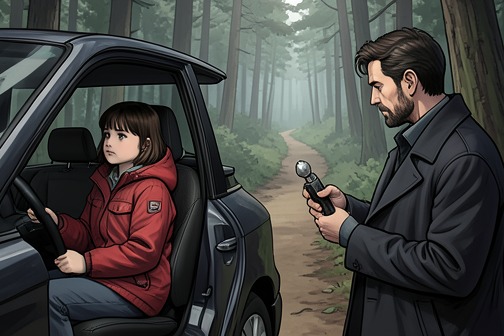
The abduction of [Melissa Walsh](entity:character-recall-character-melissa-walsh-4644f6d97afa) shifts the ricin case from an investigation into past deaths to an urgent effort to keep a missing child alive. Captivity leaves [Melissa](entity:character-recall-character-melissa-64b753949b14) isolated, frightened, and without easy access to her asthma inhaler; her rescue does not end the harm, and the aftermath makes clear that recovery will take time. The novel places this private ordeal against a police inquiry working under severe time pressure and uncertain evidence.
## Background and investigative stakes
The case is already shaped by the deaths caused by poisoned pellets. A doctor explains that the attacker likely intended not only to kill, but to make the victim’s death prolonged and painful. Later, Jo learns that an antidote exists, but its usefulness is sharply time-limited: it is generally effective only during the first twenty-four hours after exposure, while lethal poisoning may become irreversible after just four hours. The threat is therefore not merely that another person may be attacked; delay can determine whether treatment can help.
The investigation also has to operate without a clear suspect. Jo asks colleagues to pursue public reassurance and covert intelligence, including possible motives and names circulating among criminal networks. Meanwhile, the inquiry is already well past the moment of the shooting: Jo notes that eighty-three hours have elapsed, and officers have paused some enquiries until the following day. Those details establish the case’s strained tempo before [Melissa’s captivity](entity:state-recall-state-melissa-s-captivity-cd5ec829417d) becomes a direct human emergency.
## Captivity and Melissa’s perspective
Melissa’s experience is presented from within the limits imposed on her. Bound and gagged, with a hood obscuring her surroundings, she worries that her blocked breathing could worsen into an asthma attack. The fear itself makes breathing feel harder, while the inhaler she needs is no longer close at hand. She has tried to tell her captors about her needs, but they do not respond in a way she can use. Her dependence on an inhaler turns a familiar medical condition into an immediate vulnerability.
Her disorientation is part of the captivity, not a separate inconvenience. Unable to tell the time, Melissa works out whether it is night or day from a small gap in the hood. She reconstructs details of the place and her captors in the hope that the police will find them, holding on to the possibility that what she remembers may later be useful. At the same time, the lack of control over basic needs and the captors’ treatment of her deepen her distress. The account makes clear that she is not simply waiting to be found: she is trying to observe and endure while the conditions of confinement limit both.
Later, the captors remove her hood, but the return of sight does not bring relief. Melissa hears a phone conversation elsewhere in the house and recognizes the voice she has privately named [The Boxer](entity:character-recall-character-the-boxer-b65c5efd0482). She cannot make out the exchange, and the distance leaves her unable to know what is happening or what it means for her. With no hood to block the light, a barking dog repeatedly disturbed by passing planes, and the memory of how she has been left, rest remains elusive.
Her emotional response changes over the course of the ordeal. Anger at her parents and their associates gives way to self-blame; she interprets their failure to come for her as evidence that she is not lovable and that her academic performance disappointed them. In this moment, captivity narrows her sense of the future until she believes that her death might be preferable. The narrative does not present this conclusion as a fact about her worth, but as a measure of how completely isolation and fear have distorted her view of herself.
## The turning point and rescue
The threat becomes explicit when The Boxer enters her room, handles a box-cutter in front of her, and tells her not to get comfortable because it will soon be time to say goodbye. After he leaves, Melissa hears activity outside and believes her captors are preparing to depart without her. Panic triggers a tightening in her chest; she searches beneath the pillows, finds her inhaler, and uses it. She is left frightened and dizzy, but alive. The inhaler is a concrete means of keeping herself safe in a situation where nearly every other form of control has been taken away.
The rescue occurs during an armed confrontation. As Clements edges back toward cover in the woods, police warn him to stand still, but Jo understands that officers cannot fire while his pistol is aimed at the girl. Melissa bites his hand, breaking his hold; she runs, falls against a tree, and Jo reaches her and wraps her arms around her. Clements remains close, his weapon lowered but still present, as officers order him to drop it. The rescue is therefore neither a simple escape nor an end to danger: Melissa’s act creates an opening, and Jo’s immediate protection places herself between the child and the armed suspect.
## Attribution and aftermath
After Melissa is safe, Jo tells [Agata](entity:character-recall-character-agata-103135b06f69) that a person held against their will may not be able to make the seemingly obvious choice to walk toward a road and seek help. Melissa may have feared becoming more lost, may have thought an open place would make it easier for rescuers to find her, or may simply have felt safer where she was. Jo also allows that the captors may have warned her not to move. The possibilities are left unresolved, resisting the assumption that a victim’s actions can be judged as though fear and disorientation were absent.
The question of who arranged the kidnapping is likewise not settled. Jo’s leading theory is that [Ronnie O’Neill](entity:character-recall-character-ronnie-o-neill-8f82999888b7) was behind it and that Steve Yates, using a series of burner phones, organized the abduction. She sees Yates’s disappearance as suspicious and connects his return to [Jason O’Neill](entity:character-recall-character-jason-o-neill-dd0eff31da96)’s home with the moment Melissa’s detention was no longer useful: once [Darren Clements](entity:character-recall-character-darren-clements-84b771bbc219) became the prime suspect, the kidnappers had no reason to keep her. These are investigative conclusions, not a confirmed account of the perpetrators’ identities or methods.
Melissa receives a first session with a child counsellor specially trained to support her. Jo says she was not physically harmed or sexually abused, while emphasizing that her mental and emotional recovery remains the central concern. Her mother plans to take her to Disneyworld the following week despite professional advice that returning to school and friends would be better. Melissa is not speaking to her father and blames him for the ordeal; Jo doubts that their relationship will ever be the same. The rescue ends the immediate captivity, but the novel refuses to treat physical safety as equivalent to psychological repair.
## Narrative significance
The abduction links two kinds of urgency. In the poisoning investigation, time is measured by the brief window in which an antidote may work; in Melissa’s captivity, it is experienced as uncertainty, dependence, and the inability to know what will happen next. For Jo and the police, the kidnapping raises the stakes from identifying a killer to protecting two people still at risk. For Melissa, survival depends on small acts of attention and action, including using the inhaler and biting her captor when an opening appears.
The aftermath preserves the difference between rescue and recovery. Melissa is found, receives specialist support, and is no longer in her captors’ hands, yet her isolation has altered how she understands her family and herself. Likewise, the police have a plausible theory about the abduction but no definitive resolution in the account. By keeping both the emotional consequences and the investigative uncertainty in view, the episode remains more than a suspenseful rescue: it shows what the crime leaves behind, and how much remains unsettled after immediate danger passes.
Event 17
Rescue of Melissa Walsh
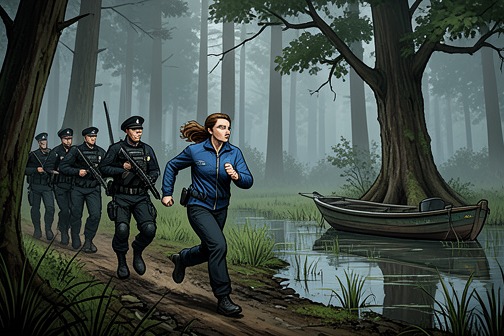
The rescue of [Melissa Walsh](entity:character-recall-character-melissa-walsh-4644f6d97afa) is the decisive recovery at the end of the search for the kidnapped twelve-year-old. A coded message directs [Agata Kowalski](entity:character-recall-character-agata-kowalski-fd7e75a74ae9) to [Delamere Forest](entity:location-recall-location-6f04b824d225); despite being told to wait for police, [Agata](entity:character-recall-character-agata-103135b06f69) enters the woods and finds [Melissa](entity:character-recall-character-melissa-64b753949b14) on the wetland, where officers soon join them with the inhaler Melissa needs. The scene brings the investigation’s procedural uncertainty and the urgency of a child’s survival into direct contact, while making Agata’s disobedience the immediate means by which Melissa is found.
## The investigation and its uncertainties
The rescue follows an investigation that has been methodical but short of a clear lead. At an early review, the team consults a laminated digest of the [Murder Investigation Manual](entity:rule-recall-rule-murder-investigation-man-5334bf950ea3) and uses its checklist of investigative-strategy elements to organize the work. Crime-scene examination, forensic follow-up on tissue samples, and the timing of the post-mortem are among the practical matters [Jo Stuart](entity:character-recall-character-jo-stuart-5a4f22fe2dbd) tracks against the manual’s framework. The procedural detail establishes that the rescue comes after sustained investigative work, not after a single obvious clue has solved the case.
Jo also sets an information-sharing principle for [Operation Alecto](entity:event-recall-event-operation-alecto-484ae5331b4a): the whole team is to hear the same crime-scene updates, whatever each person’s role, because any member may notice the missing piece. That approach is both an operational choice and a contrast with the urgency that later confronts Agata. Shared information can coordinate an investigation, but the possibility that Melissa is still in danger creates a moment in which waiting for official arrangements feels intolerable to the person who has located her.
The wider inquiry has compiled names of people who might hold grudges against either of the victims, but the lists do not overlap. Investigators are also working through partial boot prints, fabric recovered at the [Manchester](entity:location-recall-location-manchester-4236006a4a66) crime scene, and extensive passive camera data, including fixed-speed and ANPR footage. The ricin is raised as a potentially distinctive clue, but the evidence available at this point does not establish that it will identify the offender. The combination of many lines of enquiry and no confirmed suspect underscores the gap between accumulating evidence and finding Melissa in time.
A later search operation shows the same limits in the field. Jo reports that initial searches have found no sign of the suspect and that dog handlers detected neither weapons nor drugs nor the specific substance under investigation. She is preparing to send in a biohazard Forensics team despite a question about whether further checks are necessary after the dogs have searched. These negative results do not resolve the case; they make the later location message all the more consequential, because it supplies a place to act on when systematic searches have not located the missing girl.
## The coordinates and the decision to go
The immediate lead reaches Agata through a message relayed by a newspaper. The caller gives a sequence of numbers and warns that time is running out and the weather is worsening. At first, the information is not self-explanatory. When Agata replays it and writes the numbers down, she recognizes them as geographic coordinates rather than spoken words. Their meaning turns a vague warning into a specific destination and lends urgency to the final warning.
Agata enters the coordinates into Google Earth. They pinpoint a place in Delamere Forest, half a mile from Hatchmere. She tries to call Jo, but Jo’s phone is switched off, so she contacts [Max Nailor](entity:character-recall-character-max-nailor-7de32d030047), whose number is saved in her phone. Max has her read the coordinates slowly while he records them and enters them into his satnav. Agata is at Bucklow Hill, seventeen miles from the destination, with an estimated journey time of twenty-seven minutes.
Max does not treat the message as verified fact. He warns that it may be a wind-up, a diversion, or a trap, and tells Agata that a civilian must not go into the woods at risk to herself and Melissa. He is already on his way, will ask Cheshire Police to send a patrol car, and will call for air support. He directs Agata to wait at the Hatchmere crossroads, by the Delamere Fortune Palace restaurant. His caution expresses the legitimate risks of acting on an unconfirmed message; Agata’s response expresses the equally immediate possibility that a twelve-year-old is frightened and exposed to the cold.
At the crossroads, Agata sees police lights in the distance. Rather than stop in the restaurant car park as instructed, she drives past the cottages and into the forest. The narrative presents this as a deliberate choice, not an accidental detour: she has heard the warning, recognizes that officers are approaching, and nevertheless continues toward the coordinates. The rescue therefore depends on a conflict between coordinated police response and an individual’s decision that the child cannot safely wait for it.
## Finding Melissa
The satnav marks the destination at a leaf-strewn lay-by. Agata is not equipped for a forest search: she has ordinary shoes rather than boots and no proper parka. She puts on the waterproof jacket kept in her car and takes the flashlight Jo had persuaded her to buy, which also functions as an emergency escape hammer. In the rain, she searches the woods without knowing which direction to take. The specific items she has with her are improvised resources, not specialist equipment, reinforcing the disparity between her determination and her preparation.
Police shouts and a helicopter overhead do not immediately stop her. As the trees thin, she reaches a bank above wetland, loses her footing, and lands on peat. In the helicopter’s searchlight she sees a heap covered by green tarpaulin, about forty yards away. Crossing the uneven ground, she reaches it and pulls the covering back. The search has narrowed from coordinates and dark woodland to a single object beneath the light; the distinction between a possible clue and the missing child is resolved at close range.
Melissa is curled beneath the tarpaulin, wrapped in an oversized, dirty parka. Her school uniform trousers and one uncovered foot indicate that she has been left in inadequate clothing, and she is shaking with her eyes shut. Agata kneels and holds her, telling Melissa that she is safe. The rescue is thus not merely the discovery of a location: Agata identifies Melissa and gives her immediate reassurance while the child is still visibly distressed.
Two police officers reach them with torches. One rebukes Agata for acting recklessly, while the other tells him to stop and take account of their condition. The second officer kneels beside them holding an inhaler. The object connects the search’s danger to [Melissa’s asthma](entity:state-recall-state-melissa-1e8802506e9d) and provides a practical response at the moment she is found. Agata is too affected by the cold to answer with thanks; the arriving officers take up the care and protection that her solo search could not provide.
## Consequences and narrative significance
The rescue changes the case’s immediate stakes: Melissa is no longer missing in the forest, and the search becomes a recovery with police physically present. The ending does not erase the risks involved. Max’s warnings about a possible trap were real, the forest conditions were hazardous, and Agata had entered without suitable clothing or equipment. The officers’ mixed response—one condemning her decision, the other attending to the pair—preserves that tension rather than presenting her choice as uncomplicated procedure.
The event also makes the investigation’s different methods visible at once. The coordinates are decoded through Agata’s recognition, checked and relayed by Max, and met with plans for police and air support; the searchlight and officers then converge on the same location. Yet Melissa is found because Agata crosses the boundary between waiting for an organized response and acting on uncertain information. The scene does not prove that the investigative process was useless: it shows both the value of coordination and the limits of procedure when a specific lead carries an urgent human consequence.
The book’s preceding attention to review checklists, shared crime-scene updates, forensic work, camera data, and negative searches gives the final location discovery its force. No single investigative item among those efforts had yet supplied a confirmed suspect or Melissa’s whereabouts. The coordinates instead transform a delayed, indirect message into a destination, while Agata’s decision turns that destination into contact with the girl. The rescue closes the immediate search through a collision of organized police response, incomplete evidence, and personal initiative.
Event 18
Trafford Centre standoff and death of Darren Clements
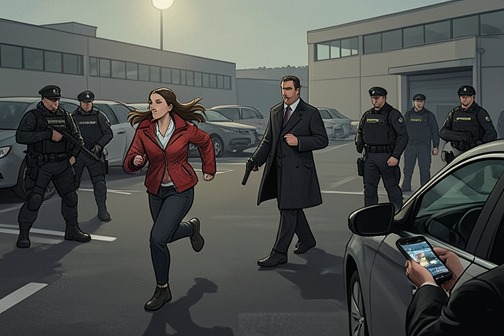
The [Trafford Centre standoff and death of Darren Clements](entity:event-recall-event-7957f4e6541f) is the confrontation in which a hostage’s resistance briefly breaks Clements’s hold, but he escapes the armed police and dies after running onto the M60. For [Jo Stuart](entity:character-recall-character-jo-stuart-5a4f22fe2dbd), the episode ends the immediate threat to Françoise Mwamba while leaving a different consequence: the sight of Clements’s fatal collision, and her presence in the pursuit, become a source of lasting distress and guilt.
## The hostage situation
The crisis reaches its decisive point after Françoise’s grandfather, [Henry Mwamba](entity:character-recall-character-henry-mwamba-ada10b46c259), switches on his phone to tell Françoise’s parents they are going to eat first. [Nick Carter](entity:character-recall-character-nick-carter-8c8f36fe5263) realizes that the phone may receive the officers’ messages. As the girl leaves the car and heads across the parking lot towards the grass, Jo cannot stop herself from shouting for her to get back. She quickly returns to operational control, reporting Françoise’s movements over the radio and demanding the location of the firearms commander.
The officers converge as Clements has Françoise in his grasp. He raises his pistol, and [Carly Whittle](entity:character-recall-character-carly-whittle-f3151a4c52cb) rushes in to tackle Henry, pinning him to the bank and obstructing Clements’s line of fire. Armed officers spread into a semicircle with their weapons trained on Clements. They identify the weapon as an [IZH-Baikal MP-46M](entity:object-recall-object-izh-baikal-mp-46m-92d9d3360945) .177 target air pistol, described as non-lethal except at close range, but Nick warns that it may be laced with a toxin. The uncertainty makes the threat immediate even though the pistol is not a conventional firearm.
Jo addresses Clements with both arms raised and her palms open. She urges him to release Françoise, insisting that the girl is innocent, and tells him that the officers understand what brought him to this point and are willing to talk. For a moment, he appears close to complying; then he edges back towards the cover of the woods, still holding Françoise. The armed officers do not fire while the pistol is trained on the child.
Françoise breaks the standoff herself by biting Clements’s hand. He lets go, and she runs, stumbles against a tree trunk and falls. Jo races up the bank and wraps her arms around the girl. Clements stands nearby with the pistol hanging at his side while armed officers shout for him to drop it. His stunned expression leaves Jo unsure whether he will raise the weapon again. At this instant, the immediate danger to Françoise has receded, but the confrontation has not yet reached safety: Clements turns away and runs into the woods.
## The pursuit and collision
The armed commander refuses to send officers into the woods: with Clements apparently no longer armed, a search on foot could put officers at risk of shooting one another. Instead, the police call for air cover to track him and wait for him to emerge. Jo nevertheless follows. She bursts through the trees and sees Clements ahead, running towards a marked crossing in the perimeter fence; she closes to fifteen yards as he passes through the gap, with a mobile unit following behind.
A drone operator tracks Clements along a pedestrian and cycle path towards the Redclyffe Circle roundabout, then reports that he has turned towards the [M60 motorway](entity:location-recall-location-m60-df69ecbd0d60). Jo runs up the rising slip road after him. Near the summit, beside a yellow sign promising free recovery and rescue, she is five yards behind. Clements turns onto the hard shoulder and runs into the slow lane. Jo stops and calls for him to stop, warning him not to be stupid. Halfway across the second lane, he looks back over his shoulder.
The traffic turns the pursuit into a fatal collision. The first approaching car swerves into the fast lane, and another crashes into the central barrier. A second car cannot react in time: it hits Clements head-on, throws him onto its windscreen and over the roof, and sends him into the path of a diesel tanker. Police watching the control-room screens hear the drone operator report that Clements is down. The escape from the woods has ended not with an arrest but with his death on the motorway.
## Jo’s immediate aftermath
The collision is shown to the police in the Control Room, but its consequences are bodily and immediate for Jo. She closes her eyes, bends over with her hands on her knees, and gasps for breath, trying to quiet the pounding in her chest. Then she switches off her Airwave radio, mutters, “Shit! Shit! Shit!”, and retches onto the bare earth beyond the guard rail. The sequence moves from the drone operator’s controlled report that Clements is down to Jo’s physical collapse: the pursuit has ended, but witnessing his death has not become a manageable operational fact.
The account does not present Jo as having caused the collision. In the aftermath, [Gordon Holmes](entity:character-recall-character-gordon-holmes-5ee9c071ebfe) stresses that she was not in a car and that this was not technically a pursuit, telling her that it was not her fault and that nobody blames her. His reassurance identifies the burden she carries: despite the distinction between following Clements on foot and a vehicle pursuit, she has seen his death at close range after chasing him and calling for him to stop. The episode’s ending therefore couples the rescue of Françoise with Jo’s distress and the unresolved weight of being present at Clements’s fatal end.
## Significance and aftermath
The collision closes the immediate pursuit without resolving its emotional cost. Jo has helped save Françoise, yet Clements’s death follows a moment in which he escaped the armed officers and ran into traffic despite Jo’s warning. Her reaction is recorded in her body rather than through an explanation: she bends over, struggles to catch her breath, switches off her radio, and retches beside the motorway. The contrast between the drone operator’s measured report and Jo’s physical collapse marks the difference between registering an incident and living through it.
Gordon Holmes later insists that Jo was not in a car, that the incident was not technically a pursuit, and that Clements’s death was not her fault. His reassurance answers the guilt that attaches to Jo’s presence in the chase, but does not undo what she witnessed. The event thus ends on two unequal outcomes: Françoise is freed from Clements, while Jo is left carrying the sight of his death and the distress of having followed him to the motorway.